
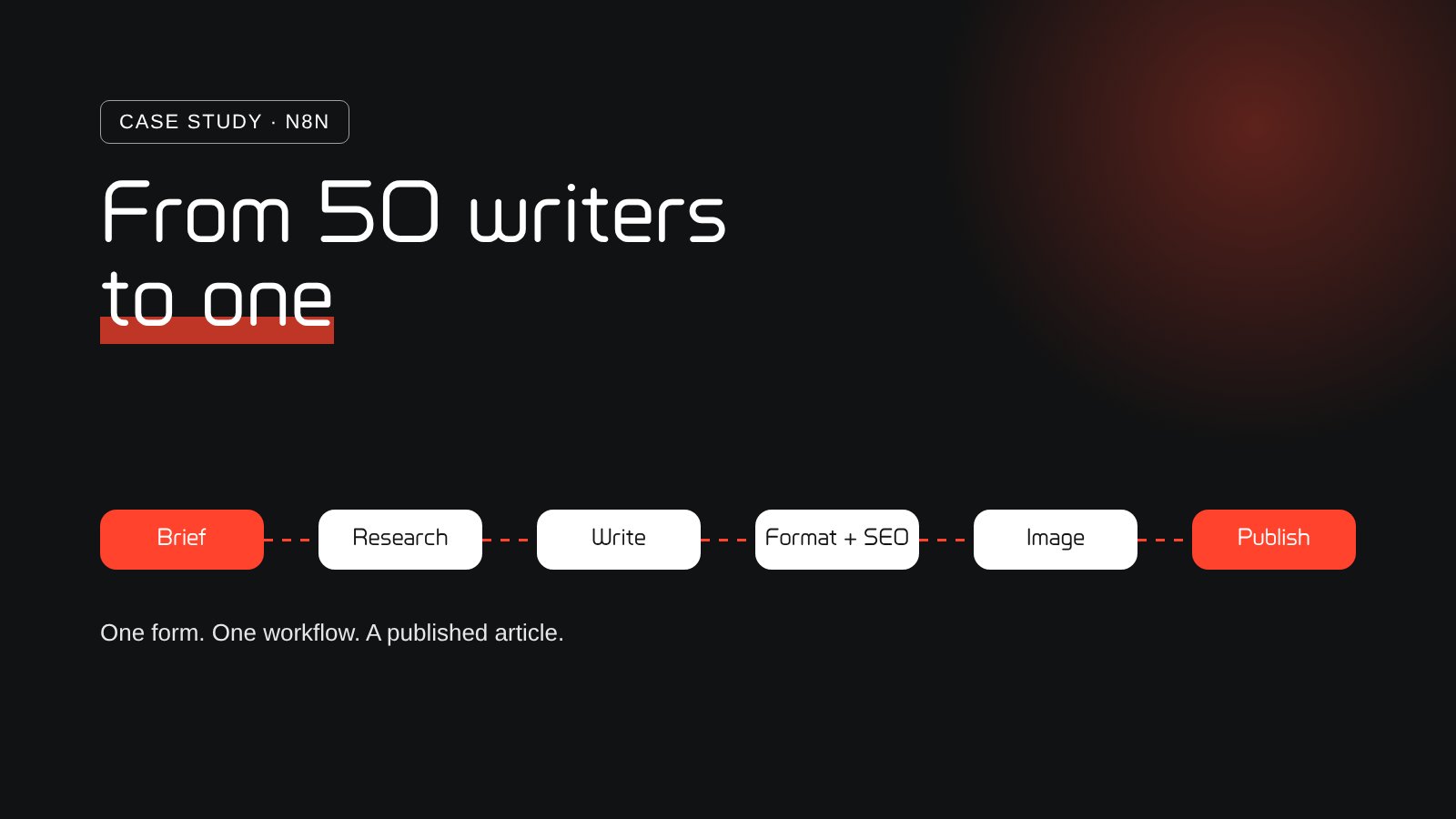
Running a content business used to mean running a newsroom. Researchers gathered sources, writers drafted articles, editors fixed the formatting, SEO specialists wrote titles and meta descriptions, designers created images, and someone had to upload it all to WordPress. For a publisher with a steady output, that meant a team of around 50 people, plus the coordination to keep them in sync.
Today the same output runs as a one-man show. The difference is a single workflow built in n8n, an open automation platform that connects apps and AI models step by step.
The challenge
Every article followed the same path, and every handover between people cost time and money. Most of the work was repeatable: research the topic, write to a brief, format the text, optimise it for search, add an image, publish. The creative decision was simple: what should we write about next? Everything after that was process.
The solution: one workflow, seven stages
We rebuilt the editorial process as one automated flow. A single form starts everything.
- Briefing. One person fills in a short form with the topic. Submitting it is the trigger.
- Research. The workflow sends the topic to an AI research service (Perplexity), which returns current facts and sources. A cleanup step tidies the list of source links.
- Writing. A writer agent, powered by a GPT model, drafts the full article from the research, following a fixed brief for tone, structure and length.
- Formatting and SEO in parallel. Two tasks run at the same time. One AI step turns the draft into clean HTML. A second agent creates the title, URL slug and meta description, returned in a strict, structured format so nothing breaks downstream.
- Combining. The two branches are merged and bundled into one complete article package, and a final cleanup step makes the HTML ready for the website.
- Publishing. The article is sent straight to WordPress through its API, with title, slug and meta data in place.
- Image. An AI model generates a matching featured image, uploads it to the WordPress media library and attaches it to the post.
From form to published article, no copy-pasting, no file transfers and no waiting for the next person in the chain.
The result
- From around 50 people to one. The owner now handles the topic plan and quality control. The workflow does the rest.
- Minutes instead of days from idea to published article.
- Consistent quality. Every article follows the same brief, structure and SEO rules.
- Costs that scale with output, not with headcount.
Why it works: keep it simple
The workflow is powerful because each step does exactly one job. Research researches, the writer writes, the formatter formats. When something needs improving, you change one step, not the whole system. That is our mission in practice: simple processes deliver.
Automation does not remove responsibility. A human still chooses the topics, sets the rules and checks the results. What disappears is the repetitive work in between.
Could this work for you?
Any business that produces content regularly can automate large parts of the process: blogs, product descriptions, newsletters or social posts. Request a complimentary consultation and we will map out which steps in your editorial process can run on their own.
